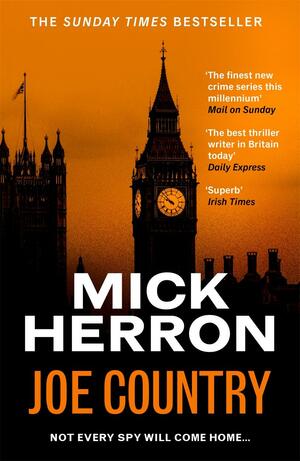
The blurb:
In Slough House, the backwater for failed spies, memories are stirring, all of them bad. Catherine Standish is buying booze again, Louisa Guy is raking over the ashes of lost love, and new recruit Lech Wicinski, whose sins make him outcast even among the slow horses, is determined to discover who destroyed his career, even if he tears his life apart in the process.
With winter taking its grip Jackson Lamb would sooner be left brooding in peace, but even he can't ignore the dried blood on his carpets. So when the man responsible for killing a slow horse breaks cover at last, Lamb sends his crew out to even the score.
This time, they're heading into joe country. And they’re not all coming home.
Joe Country is a bit of a turn away from the previous Slough House novels in some ways.
The prose, always biting, is up to par and the plotting is, as usual, spot on. What's new is the amount of backwards referrals; you can jump in here and the book will catch you up, but the Old Bastard's funeral, for example, carries a lot more heft if you've read the previous books; you know why River is so adrift and why Harkness turning up at the graveside is so much salt in such a raw wound. You know why Louisa reacts so strongly to a phone call from Min Harper's ex-wife, and why she agrees to help her out. You can get up to speed via the book itself but you're much better off reading the previous ones. I think that's the first time it's been such a necessity; even the initial introductions of JK Coe and Lech Wicinski via the novellas Nobody Walks and The Drop respectively aren't as necessary, I think.
A side note: is it just me or is the novella coming back a bit in popularity? I can't think of many times when it's been possible to get them published like this, but Herron's make interesting reading, filling in bits of lore around the edges.
Back to Joe Country. One of the themes that's run through the books is loss; everyone has lost, or loses, someone. River never knew his father, was pretty much abandoned by his mother, and has been losing his grandfather slowly as the OB's dementia takes hold; Louisa's lost Min; Shirley's lost Marcus and so on. The only person who hasn't lost is Roddy Ho and that, in large part, is only because of the colossal levels of self-delusion he carries around with him. It's not even a defense mechanism; everything could work out just fine for him and he'd still be like this, or wose. But everyone else who shows up as a slow horse has lost, or is losing, something or someone vital to them. That continues to be a central driver in Joe Country; without those past losses, the plot wouldn't turn out the way it does. Which, now I think about it, comes back to that first point about Joe Country relying more on history than the other novels.
The plot is a cracker too. When you consider how much of the book takes place over a fairly short span of time, with movements around a chunk of Welsh landscape being vital, clarity in who's going where is pretty important, and Herron keeps it all together and makes it all make sense. He's always been pretty good at conjuring up a sense of place around Slough House—each book's introduction is essentially a new view on just how crumbling and miserable a dump the place is—so it's something to see that expanded to a landscape that's vastly different.
The same sly humour and satirical digs are there, but they're overlying a plot that feels darker and more downbeat this time around. Even though the death count among the slow horses has always been non-zero, Joe Country emphasises how precarious their existence really is.
Started: 13 October 2025
Finished: 18 October 2025
Back home.
More books.